



Cribl Edge 4.17.0
| PRODUCT | DATE | RELEASE | ADDITIONAL RESOURCES |
|---|---|---|---|
| Edge | 2026-03-11 | Feature | Known Issues, Cribl Stream Release Notes |
Cribl Edge 4.17.0 includes significant performance improvements, new capabilities, and important bug fixes.
Important Changes
Action Required: End of Life Notice for AWS SDK v2
AWS ended support for their AWS SDK for JavaScript v2 on September 8, 2025. This SDK is used by Cribl AWS Sources and Destinations. To ensure uninterrupted operation and compatibility, we upgraded our SDK to v3 in the September 2025 Cribl release and will completely remove the v2 SDK in May 2026.
What you need to do: Plan to upgrade your Cribl deployment to the latest version by March 2026 to ensure continued compatibility with AWS Services.
Notice for Leader HA Users
Due to stability and performance improvements, Cribl is increasing our system requirements for Leader High Availability (HA) systems. Beginning with this release, the following is required:
- Make available enough local disk space on the Leader for double the size of your git repository in addition to all your configuration files, plus a 10 GB buffer.
- Ensure your NFS system supports updating
mtime. - If there’s a git timeout configured in the
local/cribl.yml, ensure that it is equal or greater than the system default of 10 minutes. - Consider increasing timeouts for any health checks configured for Leaders. The specific values will depend on your deployment, size of repository, size of the
groupsdirectory, and number of configuration files, but in general we recommend timeouts of 2 minutes for smaller deployments, 5 minutes for deployments with > 50 Worker Groups/Fleets, and 10 minutes for >100 Worker Groups/Fleets.
This guidance is increased in comparison to the values announced in 4.16.0 release notes.
Netflow Integration Changes
The Netflow & IPFIX Source and Netflow Destination are no longer available in Cribl Edge.
New Features
Support for Datadog Traces
Both the Datadog Agent Source and Datadog Destination now support APM traces so you can ingest and forward high-volume application traces.
New Cribl.Cloud Regions
Cribl.Cloud is now available in four new regions, Paris, Ireland, Tokyo Japan, and Sao Paulo Brazil. New organizations can use these regions as their home region.
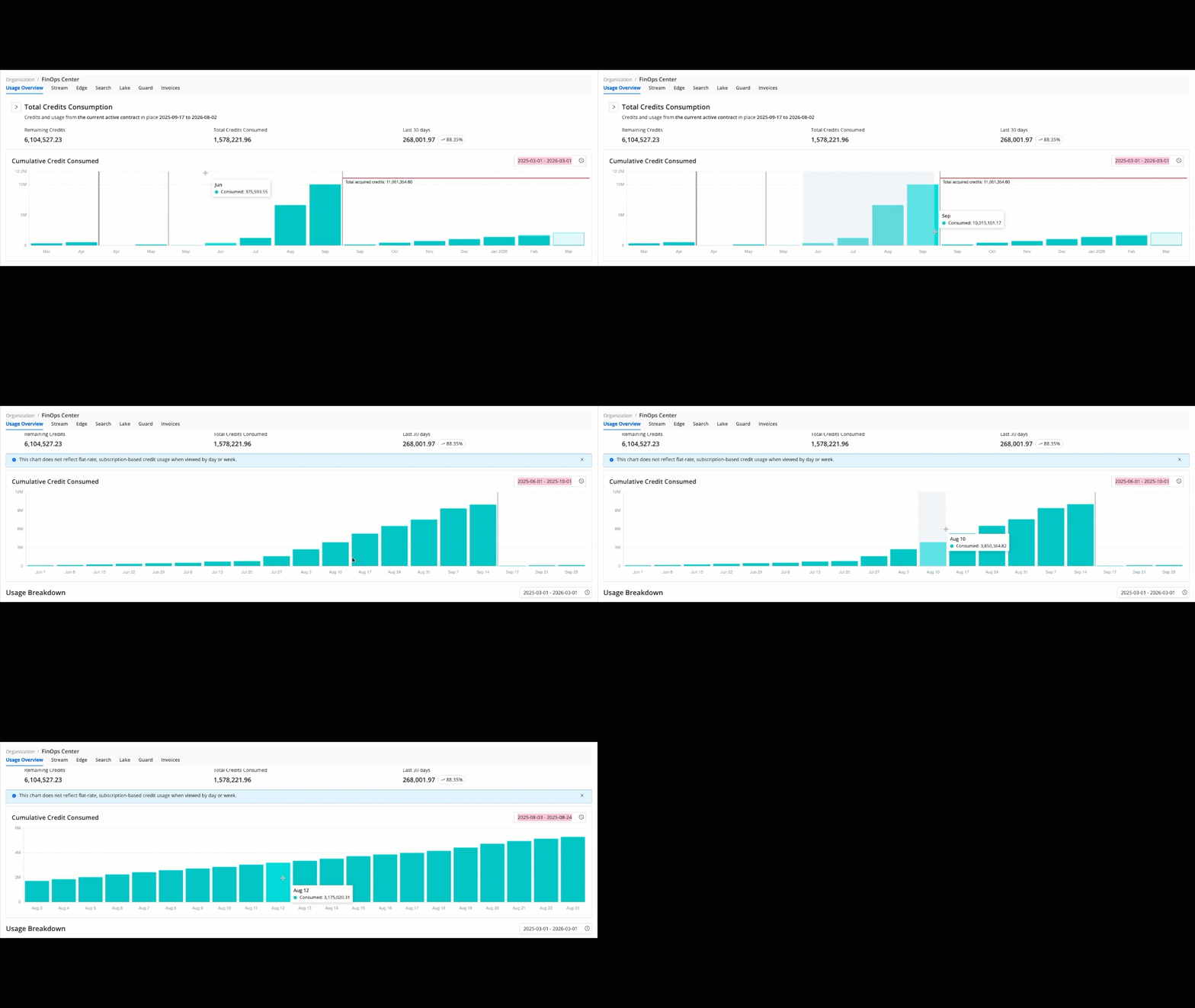
Zoom-in on FinOps Center Bar Graphs
In the FinOps Center, you can now quickly zoom in on any bar graph to view more granular data in a smaller window of time without needing to manually adjust the time filter. Simply click and drag your cursor to zoom in to specific areas of any bar graph.
Custom AI Provider Support: Bring Your Own Model
Cribl now gives organizations the flexibility to Bring Your Own Model (BYOM) by supporting custom AI providers. This offers deeper control over data privacy and compliance, and clearer visibility into AI usage and spend across both Cribl.Cloud and on-prem deployments. This feature allows you to route Cribl AI features through your own managed LLM instead of the default Cribl-managed Al model. You can configure a provider at the Workspace level for Cribl.Cloud or the Global level for on-prem to maintain direct oversight of your AI traffic and existing vendor contracts.
Initial support covers foundational models via OpenAI (Microsoft Foundry) and Anthropic (Amazon Bedrock) for inference, with broader model families and providers planned for future releases. Note that this feature is not currently available in Cribl.Cloud Government. To get started, navigate to AI Settings to enter your provider details and managed API key.
Cribl MCP Server Now Generally Available for On-Prem and Cribl.Cloud
The official Cribl Model Context Protocol (MCP) server is now available for on-prem deployments, enabling AI assistants to interface directly with your Cribl environment. All deployment modes support system metrics, alerts, and viewing Source and Destination configurations. Cribl.Cloud environments unlock additional functionality, including management of Worker Groups and Cribl Lake datasets, as well as full Cribl Search capabilities, such as natural language-to-KQL translation, job results, and Notebook management.
Cribl Search Destination
You can now send data from Cribl Stream and Cribl Edge directly to Cribl Search using the new Cribl Search Destination. This Destination is a streamlined version of the Cribl HTTP Destination that automatically targets the local_search endpoint in your Cribl.Cloud Organization and preserves the same behavior for retries, backpressure, and persistent queues.
Experience Improvements
- The sidebar is now more accessible for screen readers and users who rely on their keyboards for navigation. These updates also improve navigation consistency throughout the Cribl suite.
- In the Edge Process Explorer you can now display the Command column to show command line options.
- You can now map Edge Nodes to Fleets by the Outpost Group they are connected to, using the
outpost.groupnameproperty. - Data samples for Fleets can now be managed centrally in the Knowledge Library. All samples are visible, even if they were captured or imported through Packs. You can also share them across Fleets in your deployment.
- The System Activity tab charts in Outpost information now show data from the last 24 hours.
- The Outpost table now includes a column for the current Config Version for each Outpost Node. The Outpost Group page now has a Config Version dropdown showing the current and past config versions.
- The Target Version button in the Outpost table now displays a warning icon when that Outpost Group’s target version is older than the Leader version.
Sources and Destinations
- New Cribl HTTP Destinations in Edge now have a default output throttle of 256kBPS. You can configure this value in the Destinations configuration options. This change only affects Edge Nodes running version 4.17.0. The output throttle of existing Cribl HTTP Destinations remains unchanged.
- The Exec Source has been extended with a Script field that lets you enter a custom script that is sent to the command’s
stdin. - The Appscope Source now shows a deprecation notice in the UI. The Source will be removed in a future release.
- The Splunk HEC Destination now supports a Throttling setting that caps outbound traffic. When sends hit this limit, Cribl Stream slows additional traffic and applies your existing backpressure behavior and persistent queue settings.
- The Google Cloud Chronicle API Destination now lets you configure an Endpoint field, so you can point traffic to alternative regional endpoints during outages or special deployments without falling back to generic webhooks.
- Improved the Azure Data Explorer Destination to cache ingestion resource metadata per Node instead of repeatedly querying the cluster for each Destination in batching mode. This helps to lower the load on Azure Data Explorer data management services, reduce throttling risk, and minimize transient HTTP reset errors during peak ingest.
- Kafka-based Destinations now include the affected topic name in error messages making issues easier to troubleshoot.
- Improved the default behavior of Cribl HTTP Destinations for Edge-to-Stream topologies so that large fleets of Edge Nodes are less likely to overwhelm under-provisioned Worker Groups. Cribl HTTP Out now honors downstream capacity signals and uses safer default retry and backoff settings, reducing the risk of Edge Node crashes and intermittent errors in high-connection, self-service environments.
- We’ve expanded I/O Observability monitoring to Splunk Load Balanced, WEF, HTTP, OpenTelemetry, MSK, Confluent Cloud, and TCP integrations. You can access these metrics through the Internal Cribl Source and view performance charts directly on each Source and Destination’s configuration page for greater visibility into your data pipeline integrations.
Packs
Connect Packs to Global Sources and Destinations
You can now transfer data in and out of Packs that contain Sources and Destinations:
- Send data from a global Source to a Pack: Route data from a Source that exists at the Fleet level to a Pack containing a Destination.
- Send data from a Pack to a global Destination: Data originating in a Pack can be routed to a Destination that exists outside a Pack.
This new workflow allows you to break down repetitive configurations into modular, reusable components. It allows specialized teams to manage the data processing and output logic for their integration without touching global configurations or impacting other integrations.
Enhanced Pack Monitoring
We’ve expanded our monitoring capabilities to give you full visibility into the internal performance of your Pack’s Routes and Pipelines. The Data > Routes and Data > Pipelines pages allow you to observe the data throughput for each of these resources in your Pack. All metrics use a structured naming convention that prefixes the Pack ID with the Route or Pipeline of interest so that it’s clear where Pack metrics are coming for more accurate troubleshooting.
Pack IDs Must Be Lowercase
Cribl Edge now requires all new Pack IDs to be lowercase. While the Cribl Leader runs on Linux (which is case-sensitive), many Edge Nodes run on Windows or macOS (which are case-insensitive). Previously, it was possible to create two different Packs named MyPack and mypack. However, deploying both Packs to an Edge Node would cause a naming conflict and deployment failure.
From this release onward, Pack IDs must now be entirely lowercase when creating or copying a Pack. The system now validates the uniqueness of a Pack name based on its lowercase string. Your currently installed Packs with uppercase characters will not be renamed or broken. They will continue to function as they do today. However, we recommend migrating them to lowercase IDs to ensure future compatibility across all platforms.
Corrections
This release contains the following bug fixes:
Operational Fixes
| ID | Description |
|---|---|
CRIBL-36754 | We resolved an issue where Subfleets would occasionally lose the Route route.yml configuration file for inherited Packs after a deployment. When Routes were missing, Edge Nodes processed data without the Pack’s intended routing logic, which occasionally led to significant increases in data throughput. The deployment process now correctly ensures that inherited Route configuration files remain intact across all Fleet and Subfleet levels. |
| CRIBL-37984 | We resolved a navigation issue where links within Notifications messages for Edge Destinations incorrectly redirected users to the Cribl Stream UI, forcing users to manually navigate back to the Cribl Edge UI to get more information. These links now correctly send you to the appropriate context in the UI, allowing for faster response times to health alerts. |
| CRIBL-36855 | Fixed an issue where Windows Edge Nodes running under a custom service account can lose configuration when upgraded via Fleet target setting. Resolves a Known Issue. |
| CRIBL-37590 | The Windows installer now correctly handles running Cribl Edge under group Managed Service Accounts. |
| CRIBL-37828 | Resolved an issue where navigating to a directory with a large number of files in the Explore > Files > Browse mode could freeze the Cribl Edge UI. |
| CRIBL-37712 | Cribl Edge no longer logs Kubernetes API errors when not running on Kubernetes. |
| CRIBL-37418 | Edge Nodes now reload TLS certificates without a manual restart after config deployments. |
| CRIBL-37548 | We resolved an issue where users with Admin permissions on a parent Fleet were unable to add Source notifications to the Subfleets. We updated the permission checks to correctly recognize inherited permissions for authorized administrators. |
| CRIBL-38353 | We resolved an issue where an upgrade of a Windows Edge Node would report success in the installation log, but fail to upgrade the binary. |
| CRIBL-34884 | We fixed the functionality of the audit log by adding a packId field to log entries. When you create, update, or delete resources within a Pack (such as Routes and Pipelines), the audit log now explicitly identifies the specific Pack where the change occurred. This makes it easier to track and audit configuration changes across your entire environment. |
| CRIBL-34521 | We resolved an issue where cloning a Fleet could cause new Edge Nodes to fail their initial configuration pull. This was caused by an incorrect version ID being assigned at the moment of cloning, which generated unnecessary log errors. The cloning process now correctly handles versioning, ensuring that new Fleets remain in a clean state until their first official deployment. |
| CRIBL-36834 | We resolved a UI issue in the Job Inspector where the Earliest and Latest times appeared to be an hour off for jobs that were scheduled across Daylight Saving Time (DST) transitions. The Job Inspector now accurately accounts for DST offsets when using absolute time ranges, ensuring the displayed job run times consistently match the expected times. |
| CRIBL-38270 | We resolved a regression in version 4.16.0 where triggered Notifications were not appearing in the Monitoring > Notifications dashboard. The underlying UI error has been corrected, and the Notifications tab now accurately displays all active and historical alerts as expected. |
| CRIBL-38219 | The Outpost Group table now displays a column for the tags added to the group. |
| CRIBL-37833 | Attempting to move an Outpost that can’t be moved due to defined environment variables now displays a clearer error message. |
| CRIBL-36500 | The Outpost table now displays a warning icon when an Outpost Node is running a version older than the Leader. |
| CRIBL-38495 | Fixed an issue where Outpost Groups would only allow selecting Leader TLS certificates in the UI. |
| CRIBL-37732 | We resolved an issue where QuickConnect allowed users to save duplicate connections between the same Source and the same Pipeline, Pack, or Destination. Previously, if a user accidentally created a second duplicate connection, it could result in redundant data processing and unexpected spikes in license consumption. The UI now enforces unique connections, displaying an error and preventing saves if there are duplicates. |
| CRIBL-37528 | We resolved an issue where the internal system tasks used to fetch Fleet logs would incorrectly report a canceled or failure status in the Job Inspector, which could lead to confusion when debugging. These background tasks now report their status accurately, ensuring that the system jobs list reflects the true health of your environment. |
| CRIBL-35455 | We resolved an issue where hitting the Return key on a confirmation modal (such as when deleting a Pipeline Function) could cause the browser to freeze. This behavior was primarily observed in Chromium-based browsers such as Arc, Opera, and Microsoft Edge. The confirmation logic has been updated to handle keyboard inputs correctly across all supported browsers. |
| CRIBL-38581 | We fixed an issue in the UI that caused pages to fail to load, showing a “no such file or directory” error on pages such as the REST Collectors list. We have updated the UI so that if the system encounters an error while retrieving your UI preferences, it will now default to a clean state instead of blocking the page from rendering. |
| CRIBL-38552 | We resolved an issue with license synchronization after high availability failover. This could lead to incorrect expiration warnings or quota limits in the UI after a transition to a standby Leader. The standby Leader now automatically reloads all licensing information from the shared failover volume the moment it becomes the primary Leader, ensuring your licensing status is always accurate and up to date. |
| CRIBL-37777 | The C.WorkerGroupId variable now correctly evaluates within Packs. Previously, this variable would return an empty string when referenced inside a Pack’s Pipeline. This fix ensures consistent access to Fleet metadata in Packs. |
| PLAT-433 | We fixed an issue that caused incorrect Team and Role mapping for Azure Active Directory (Azure AD) LDAP groups with names that contain spaces. |
Source and Destination Fixes
| ID | Description |
|---|---|
CRIBL-37928 | Resolved an issue where the File Monitor would run out of memory and restart when attempting to discover a directory with a large number of files in Manual discovery mode. |
| CRIBL-38140 | Updated predefined File Monitor Sources: in_file_auto and in_file_varlog to correctly collect from the end of files by default. |
| CRIBL-37521 | Ensured that binary files like lastlog are not collected by the File Monitor when Enable binary files is toggled on. |
| CRIBL-25674 | Fixed an issue in the Splunk Single Instance and Splunk Load Balanced Destinations where very long authentication tokens caused a buffer error, preventing Workers from sending data to Splunk indexers. The Destinations now validate header size and handle long tokens without interrupting data delivery. |
| CRIBL-32736 | Fixed an issue where metrics generated by the Publish Metrics Function could fail to send after upgrading to 4.11.1, causing Splunk Load Balanced Destinations to log The string argument must be of type string or an instance of Buffer or ArrayBuffer. Received type number (...) and drop metrics. The function now correctly handles numeric metric fields so metrics are delivered as expected. |
| CRIBL-36451 | Fixed an issue where the Azure Data Explorer Destination using Parquet format could leave orphaned .parquet files in the staging directory after upload failures and retries, causing unnecessary disk growth and raising data-durability concerns. The Destination now reliably cleans up staging files once data is successfully ingested, even when recovering from error mode. |
| CRIBL-38102 | Fixed an issue in 4.16.0 where enabling the Event Hubs Minimize duplicates option caused partition lookups to fail with Cannot read properties of undefined (reading 'fetchPartitions'), forcing the Source to default to starting consumers on all partitions. The option now initializes correctly and evaluates Event Hubs partitions as intended, preventing redundant consumption errors in production environments. |
SDK Changelogs
The Cribl SDKs help you integrate with Cribl and reduce the need for repetitive tasks. We maintain changelogs for each version of the Cribl SDKs in their GitHub repositories:
- Go SDK changelogs: control plane and management plane
- Python SDK changelogs: control plane and management plane
- Typescript SDK changelogs: control plane and management plane