




Ingest Cribl Stream/Edge Data into Cribl Search
Collect data from your on-prem or Cribl.Cloud tenants to store it in Cribl Search for fast analysis.
Before You Begin
You’ll need:
- Search Editor Permission, or higher. Learn who can do what at Cribl Search Permissions.
- Cribl Stream or Cribl Edge (on-prem or Cribl.Cloud).
- Cribl.Cloud Enterprise on both sides (Cribl Stream/Edge and Cribl Search). For details, see Pricing.
If you don’t need Cribl Stream or Edge processing, you can send data directly to a lakehouse engine, using native Cribl Search Sources such as Syslog, Splunk HEC, OpenTelemetry, or Raw HTTP.
Cribl Search also parses incoming events through Auto-Datatyping and Custom Datatypes v2, so in many cases you’re better off skipping Stream or Edge pre-processing altogether. For why this matters, see Ingest Is Measured at the Engine.
Looking for the Cribl HTTP Source in Cribl Stream instead?
1. Add a Lakehouse Engine
See Lakehouse Engines in Cribl Search.
2. Set Up Your Search Datasets
Create the Search Datasets you’ll route events into, and set their retention. See Create Search Datasets.
3. Add a Cribl HTTP Source in Cribl Search
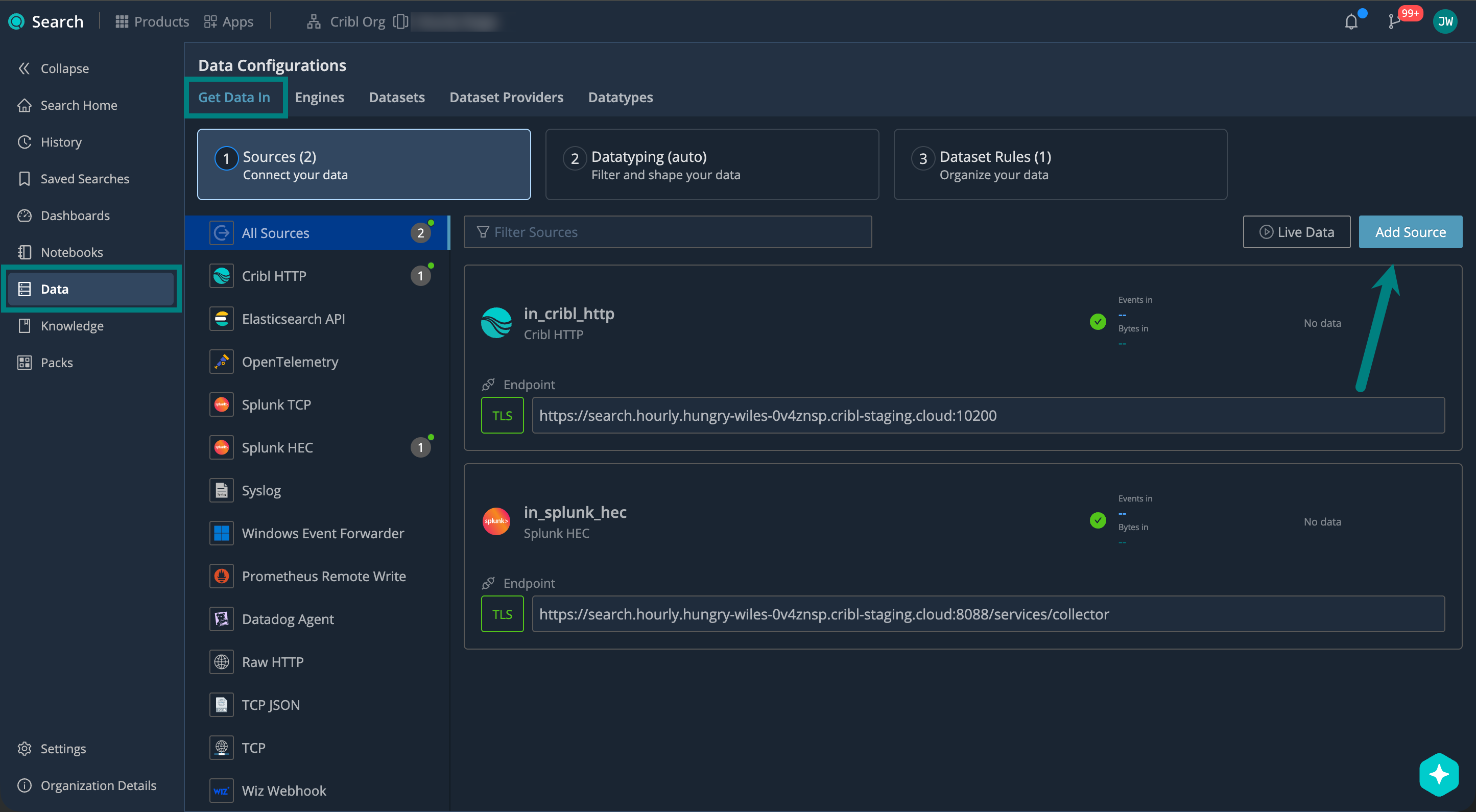
On the Cribl.Cloud top bar, select Products > Search > Data > Get Data In > Add Source > Cribl HTTP.
Describe Your Source
Under General, configure:
| Setting | Description | Example |
|---|---|---|
| ID | Source ID, unique across your Cribl.Cloud Workspace. Use letters, numbers, underscores, hyphens. | cribl_stream_prod |
| Description | Describe your Source so others know what it’s for. | Ingests data from Cribl Stream |
| Address | Hostname (FQDN) that Cribl Stream/Edge connects to (Cribl endpoint). | search.main.foo-bar-abc123.cribl.cloud |
| Port | Network port to listen on. Keep the default unless it conflicts with another service. | 10200 (default) |
| Store this source data as | Select Logs (the default), Metrics, or Both Logs and Metrics. To ingest native metrics from the Cribl Search Destination, select Metrics or Both Logs and Metrics. | Both Logs and Metrics |
Set up Authentication (Optional)
For cross-environment or cross-Workspace paths (for example, on-prem Cribl Stream to Cribl Search), you’ll need to set up authentication tokens.
Under Authentication, select Add Token. Add as many tokens as you need.
| Setting | Description | Example |
|---|---|---|
Token secret (text secret) | Reference to a stored secret containing the token. Select a secret or Create a new one. (See Create and Manage Secrets in Cribl Stream). | sec_cribl_stream_token |
| Description | Describe which clients or environments use the token. | Prod Cribl Stream |
Set Up Encryption
TLS encryption protects your data in transit. New Sources have TLS enabled by default, with TLS 1.2 as the minimum version.
TLS settings must match on both sides. Make sure TLS is also enabled on your Cribl Search Destination in Cribl Stream or Cribl Edge.
Under Encrypt, you can review or adjust the Minimum TLS version you want to accept:
| TLS Version | When to Use |
|---|---|
| 1.3 | Provides the strongest security. Use when your clients support it. |
| 1.2 | The default. Use for broad client compatibility. |
| Older than 1.2 | Avoid if possible. These versions are no longer considered secure. |
Select Save to create the Source.
4. Assign Datatypes in Cribl Stream
When data comes from Cribl Stream or Cribl Edge, you can skip Datatyping in Cribl Search, and assign Datatypes
upstream. Set the datatype override field to a stock or
custom v2 Datatype.
If events are already fully parsed upstream (fields are on the event and you don’t want Search to parse _raw again),
set the isParsed override field. Remember to set datatype too, otherwise Auto-Datatyping kicks in.
To set both fields automatically, enable automatic parsing in a supported Source, Route, or Parser Function upstream from your Cribl Search Destination.
You can also set these fields manually with an Eval function in the same Pipeline.
If you’d rather configure Datatyping in Cribl Search instead, see Shape Your Data with Datatype Rules.
5. Route Events to Search Datasets
After you create your Search Datasets, assign each event to a Dataset upstream by setting the dataset
override field in Cribl Stream or Cribl Edge. Search uses that value directly and skips Dataset
rules.
- In Cribl Search, add your Search Datasets and set their retention periods.
- In Cribl Stream or Cribl Edge, set the
datasetfield on each event to the ID of the target Search Dataset. Use an Eval function in the Pipeline that feeds your Cribl Search Destination.
Events with no dataset field, or with a dataset field pointing to a Dataset that doesn’t exist, fall back to the
main Dataset.
If you’d rather route events with Log Dataset rules in Cribl Search, see Organize Your Data with Dataset Rules.
Route Metrics with Metric Dataset Rules
If this Source stores metrics, Metric Dataset rules decide which metrics Dataset receives them. By default, a single
catch-all rule sends all metrics to the primary metrics Dataset. A rule for this Source matches
cribl_http:<your-source-id> - for example, cribl_http:in_cribl_http for the built-in Source.
Metric Dataset rules apply to data as it arrives and aren’t retroactive, so add your rule before you start sending data. For details, see Add Metric Dataset Rules.
If you relay Datadog metrics through Cribl Stream or Cribl Edge, Cribl Search converts their metric types the same way
it does for a Datadog Agent Source. For example, it stores a count as a Counter with delta temporality and rejects a
distribution. Other metrics that arrive on this Source keep their own types. See
Supported Datadog Metrics.
6. Add a Cribl Search Destination in Cribl Stream or Cribl Edge
For Cribl Stream, see Cribl Search Destination in the Stream docs.
For Cribl Edge, see Cribl Search Destination in the Edge docs.
7. Start Sending Data and Verify
Start sending events from Cribl Stream or Cribl Edge, and verify that they’re successfully flowing into Cribl Search.
On the Cribl.Cloud top bar, select Products > Search > Data > Live Data.
Here, check for your Cribl HTTP Source. For details, see Live Data. To verify metrics, on the Cribl.Cloud top bar select Products > Search > Metrics. For details, see Metrics Explorer.
Next Steps
Now that your data is in Cribl Search, you can start using it. For example: